15. BATTERY SAFETY : THERMAL RUNAWAY IN lfp VS. NMC lITHIUM CELLS
by the Blue Heron Tech Support Team
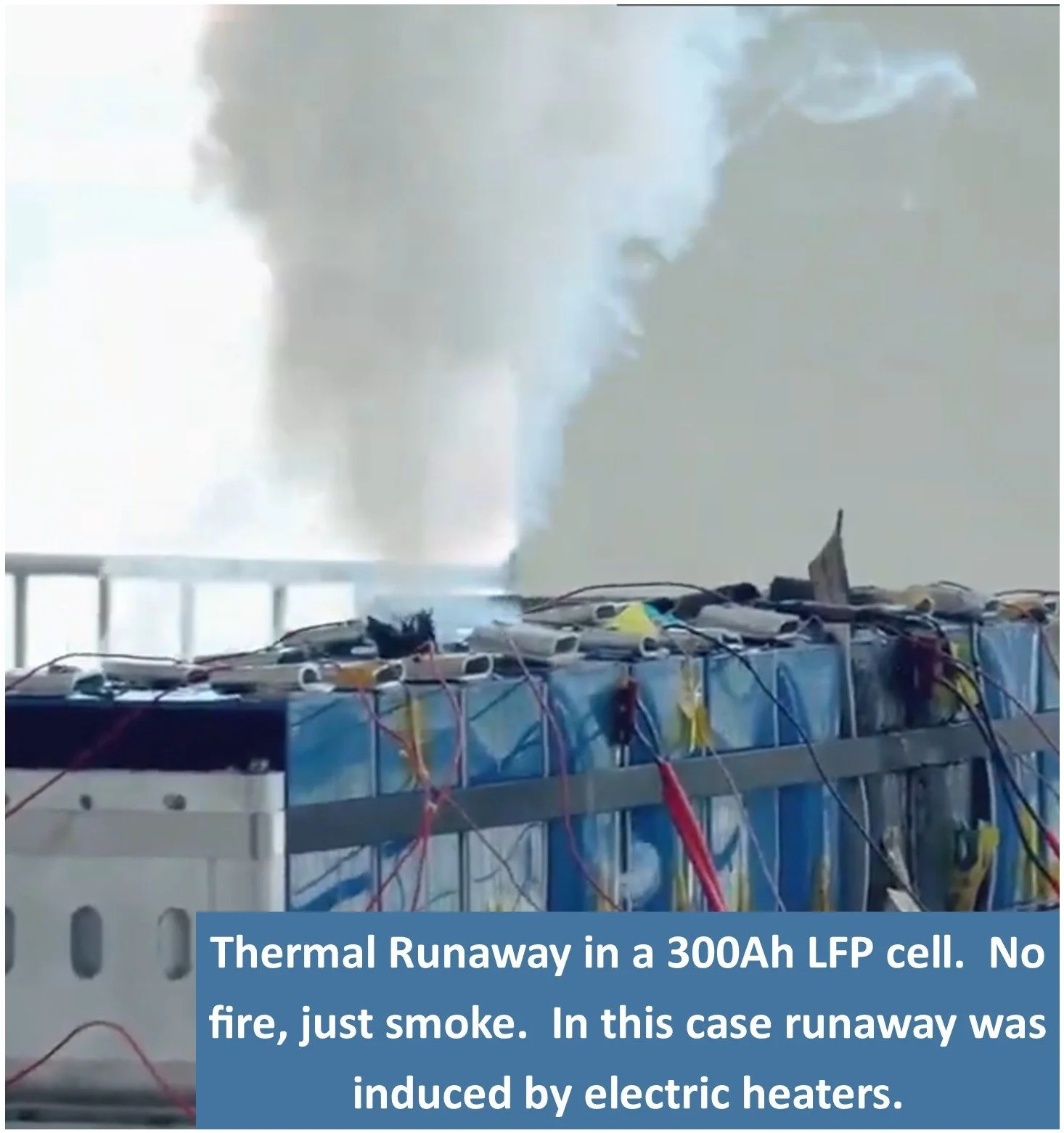
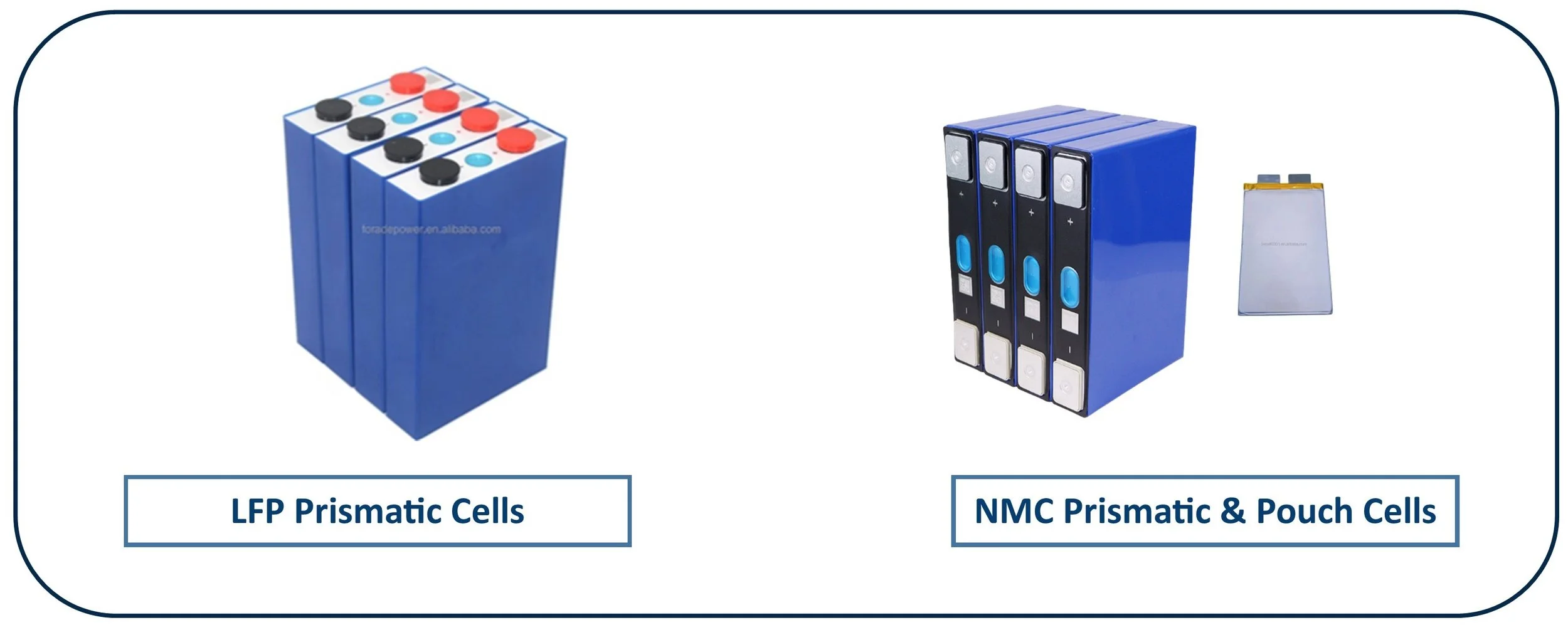
The purpose of this article is to address a subject not well understood by the general public. The subject is thermal runaway in a lithium cell, and how the two most common lithium battery chemistries, namely LFP vs. NMC[1], present substantially different characteristics in a thermal runaway event. Because of those differences, one type (NMC) is considered a high-risk chemistry and the other (LFP) is a relatively low risk. First, here is a summary of the issue.
Summary
Lithium cells with a cathode of NMC (Nickel-Manganese-Cobalt), exhibit high energy density, but have a substantially lower cycle and calendar life, are less stable, are easier to drive to thermal runaway, exhibit auto-ignition when driven to thermal runaway, are near-impossible to suppress the thermal runaway fire and must be left to run their course consuming the combustible electrolyte and often all nearby combustibles. LFP (Lithium Iron Phosphate) on the other hand are a little less energy dense, but have much longer cycle life, are much more stable, are harder to get to thermal runaway, and do not exhibit auto-ignition when driven to thermal runaway. Accordingly, NMC cells are considered high risk and LFP considered lower risk.
Due to the higher risk of NMC cells, their use is generally applied to EV models that require longer range, and personal electronics that demand high energy density due to their preferred smaller size. For life safety reasons applications like domestic solar energy storage, RV and Marine house battery banks, and small craft propulsion should use LFP chemistry.
With high quality cells, well engineered BMS units, and advanced battery charging devices, the occurrence of thermal runaway is extremely low. Choosing low risk cells, namely LFP, gives one added assurance they will not experience this condition.
Thermal Runaway Characteristics in Different Lithium Chemistries
The Role of the Lithium in a Cell
Lithium ions shuttle back and forth transporting electrons between the electrodes during normal operation. During thermal runaway, various reactions occur:
The Solid Electrolyte Interphase (SEI) Breakdown: As a battery overheats, the protective SEI layer on the anode decomposes, exposing embedded lithium metal to the liquid electrolyte. [2]
Anode Reactions: The exposed lithium reacts directly with the electrolyte, generating significant heat and causing the temperature to rise uncontrollably. [1]
The Role of the Electrolyte
In both LFP and NMC cell types, the liquid electrolyte typically consists of a lithium salt dissolved in a blend of flammable organic solvents (like alkyl carbonates). The electrolyte contributes to thermal runaway in three primary ways: [3]
Boiling and Venting: As the cell heats up, the electrolyte boils, creating immense pressure and venting flammable, toxic gases out of the cell.
Fuel Source: When these vented gases are exposed to a heat source or oxygen, they combust.
NMC cells when vented at high temperature provide the fuel, ignition source, and oxygen - all of the necessary components for a fire.
LFP on the other hand, when vented, presents only combustible gases, but no ignition sources or oxygen. The surrounding environment of course has oxygen but without an ignition source there is no fire. If an ignition source were to be present in the surrounding area, the resulting fire could be suppressed through normal means such as a CO2 extinguisher or water, as the released gases are not supplying oxygen as occurs with NMC thermal runaway. Knowing an external ignition source could compromise safety, one can design the system in such a way that no ignition sources are close by.
The Chain Reaction
Thermal runaway escalates in a distinct, cascading sequence where lithium and the electrolyte interact: [4]
1. Initiation: An external factor (like physical damage) or a runaway charger or an internal fault (like a short circuit in the cell from a near end-of-life dendrite growth) causes localized heating.
Component Breakdown: The internal separator melts, causing a direct short circuit, which rapidly spikes the temperature.
Lithium-Electrolyte Reaction: The temperature rises to the point where the lithium oxides and electrolyte begin to decompose into gases.
Venting: The pressurized gases escape through the rupture disc for both LFP and NMC types. In an LFP cell the venting looks like lifting the pressure cap off a pressure cooker where a stream of gas and particles erupt out through the vent. The gases from the LFP cell are a mix of combustible and non-combustible, but do not ignite in most case, unless there is a close-by ignition source. Allowing a close-by ignition source would be a system design flaw. However, in the case of NMC, the venting gases immediately self-ignite.
Combustion in NMC Cells: For NMC cells, in addition to venting, there is an immediate autoignition and rapid combustion of the heated electrolyte gases. The autoignition occurs from high temperature particles that result from the intense instability and temperatures in the NMC components plus a released oxygen from weak bonds in the cathode material. The released combustible gases with the released oxygen and the autoignition cause an intense spontaneous combustion. This NMC cell fire is therefore nearly impossible to extinguish due to the self-supplied oxygen.
Semi-Solid-State Cells
Solid-State batteries bring the promise of high charge and discharge rates, without the use of combustible electrolytes. They have been just around the proverbial corner for 10 years now, and still face challenging issues and further development. So they are not readily available on the market. What one finds now on the market are semi-solid state cells.
The semi-solid-state battery can be a viable option as it reduces the amount of liquid electrolyte in a cell. However, at this point, semi-solid-state cells typically have shorter cycle lives of only 500 to 1500 cycles, and still contain liquid or gel electrolyte (about 40% to 50% of that in regular NMC or LFP cells) and remain based on NMC or LFP chemistry. Accordingly, these types of cells can still experience thermal runaway, despite being called semi-solid state. And, as mentioned, ones based on NMC chemistry can have autoignition. This video illustrates thermal runaway in an NMC-based semi-solid state cell and the resulting autoignition. In this case the thermal runaway was induced in the NMC-based semi-solid state cell by a higher charge voltage than specified for the cell’s chemistry, such as could occur in the real world from a runaway charger.
The above illustrates the risk of NMC-based cells, including those that are semi-solid state. As with regular cells, LFP based semi-solid-state cells would be far safer than NMC-based solid state cells, because the LFP cells have no ability for autoignition, do not release free oxygen, are difficult to get to thermal runaway, and have a much longer life. And LFP cells are more budget friendly.
Terminology
The European press often contrasts "lithium-ion" cells with "LFP" cells for safety reasons. Chemically, this is inaccurate. Both NMC and LFP are types of lithium-ion batteries. Academic research correctly classifies both under the lithium-ion umbrella. To avoid confusion, our papers use the specific terms "NMC" and "LFP" to distinguish between the two chemistries.
Misusing the term "lithium-ion" creates confusion about the safety of Lithium Iron Phosphate (LFP) batteries. [1] For instance, an author recently wrote that "all lithium-ion batteries are susceptible to thermal runaway and auto-ignition." Readers understandably assumed this applied to LFP cells. However, the author was likely following European media standards, which use "lithium-ion" exclusively for higher-risk chemistries like Nickel Manganese Cobalt (NMC). [1, 2, 3, 4]
Because terminology varies, readers must evaluate these articles carefully. If you encounter information that is confusing in this regard, please contact us for clarification.
Battery Selection Guide for Engineers
Engineers must choose battery chemistries based on application safety risks. Research shows distinct behavior differences between these technologies.
Portable Electronics, Long Range EV, Drones (Can Use NMC or LFP Cells)
Recommendation: These type cells are appropriate for small consumer devices., long range EV, drones
Justification: Benefits include compact size and lighter weight.
Safety Factor: Users can quickly discard or escape a smoking device before it erupts in fire from autoignition.
In Occupied Spaces - House Battery Banks, Residential Solar, Boat Propulsion (Use LFP Cells)
Recommendation: Strictly required for RV and marine house battery banks, residential solar banks, and boat propulsion.
Justification: LFP technology offers significantly higher thermal safety.
Safety Factor: Due to LFP low risk, it is appropriate for occupied spaces, or when one can’t run for safety like in boat propulsion.
A Plan for Enhanced Safety
Lithium Iron Phosphate (LFP) chemistry is inherently safe and highly resistant to thermal runaway. However, you can achieve an exceptional level of safety—exceeding ABYC standards—by applying these principles we learned in designing nuclear power plant safety systems: keys are redundancy, defense-in-depth, and total quality.
We highly recommend Implementing these nine advanced engineering steps for your installation:
Use Certified Experts: Stick strictly to LFP chemistry. Have highly qualified (ABYC-certified for marine applications) technicians install or inspect the system.
Select Premium BMS Units: Choose batteries with robust Battery Management Systems (BMS) that feature multi-parameter monitoring, redundant switches, and independent thermal sensors. (Our BMS units monitor 52 parameters, dual channel controls, redundant thermal monitoring, thermal runaway shutdown features.)
Prevent Connection Fires: Clean, torque, and coat high-current DC connections with anti-corrosion coating (e.g., Boeshield or dielectric grease).
Inspect with IR Temp Sensing Gun: Run a high-current load test after installation and every two years. Scan all connections with a thermal gun to find and fix hot spots immediately.
Buy Quality Chargers: Use only UL-certified, by reputable charging brands like Victron, Mastervolt, Magnum, or Xantrex. Avoid cheap alternatives.
Regulate Alternators Externally: Install an external regulator with specific LFP settings if you charge directly from an alternator. Contact us for more details.
Insulate Terminals: Cover every battery terminal connection with rubber boots to prevent accidental shorts.
Fuse and Size Correctly: Install proper fuses and size all cables according to the maximum loads allowed by the BMS.
Eliminate Ignition Sources: Keep spark risks out of the battery compartment. Use brushless fans, LED lights, and sealed, ignition-protected electric motors.
Retire Old Lithium Batteries: Replace the battery bank once its capacity drops to 70% of its original rating.
In summary, lithium chemistry is backed by over 12,000 research papers and 20 years of real-world application, including proven variants like Lithium Iron Phosphate (LFP) and Nickel Manganese Cobalt (NMC). We know how these behave. Our personal experience includes LFP cells lasting 15 years in a full-time liveaboard environment. Across thousands of monitored applications, we have observed zero instances of battery incipient failure or thermal runaway. While LFP is an inherently reliable chemistry and most designers produce high-quality products, the market does contain low-quality exceptions promoted with exaggerated claims. Buyers must remain cautious.
July 7, 2026
________________________________________________________________
[1] LFP is Lithium Iron Phosphate, and NMC is Nickel Manganese Oxide. These are the constituents of the cathodes in these two chemistry types.
[2] Thermal Runaway in Lithium-Ion Batteries: A Review of Mechanisms, Prediction Approaches, and Mitigation Strategies, by Zeyu Chen, Jiakai Zhang, Chengxin Liu, Chengyan Yang, and Shuxian Chen, Batteries, 2026
[3] UNDERSTANDING THE LIMITS OF THERMAL RUNAWAY IN LITHIUM-ION BATTERY SYSTEMS John C. Hewson (jchewso@sandia.gov, 1-505-284-9210) Sandia National Laboratories Albuquerque, NM 87185-0836 USA 2016
[4] The Ultimate Guide to Lithium Battery Thermal Runaway, Author:Bob Wu, Published:October 2025