Buying a Lithium Battery – It is a Value Proposition
By the Blue Heron Support Team
Like a lot of things, the choice and purchase of a lithium battery bank for your boat or RV, or by a dealer or manufacturer, is a value proposition. There are several key parameters to consider when purchasing a set of lithium batteries for your battery bank:
1. Lithium cells and batteries are available in a range of quality levels;
2. Also, batteries have a range of added features;
3. Some battery manufacturers offer exceptional technical support, yet many provide little to no real support – even if they claim to;
4. Some manufacturers offer a wide range of sizes and shapes, giving one a better chance to maximize the power in a limited space – others offer very few choices;
5. Lithium batteries come in a wide range of capacity sizes (Ah), with some manufacturers offering limited options and others having a very wide range.
1. Range of Quality Levels – There are two factors here. The first is a threshold issue, and that is the “Grade.” In all cases you should go with a battery made with Grade A cells. If silent on that, skip that battery; it would say Grade A if it were made with Grade A. Also, don’t fall for “Automotive Grade,” as there is no such generally accepted term and not specified in any industry standard. Most likely those are recycled cells from an EV pack.
The “Grade A” label simply means the cells meet the acceptance criteria of that manufacturer for things like capacity, internal resistance, self-discharge rate, dimensions, etc. It does not reflect an overall industry level of quality. Meeting the Grade A label is just a threshold issue, but there are other indications of the level of quality for the cells and thus the battery pack. For example, one manufacturer’s Grade A cell may be rated for 1000 cycles and last about 2-3 years and another’s Grade A cell may be rated for 6000 cycles and have an expected life of 15 years, both of the same Ah capacity. So, the second criterion that gives one an indication of quality and expected life is the cycle rating. Our paper “Expected Battery Life & Cell Cycle Rating” discusses these factors, and how one should correlate cycle rating to an expected life for use in a boat or RV house battery bank. From a cost standpoint, you’ll find a range of cost of 3 to 4X’s, between batteries on the high end vs. batteries on the low end. All cells of the same Ah do not have the same cycle rating or expected life. And, you’ll find expected life can differ by a factor of about 8 on high end vs. low-end priced batteries. This is the largest value factor in comparing high end batteries to cheap batteries.
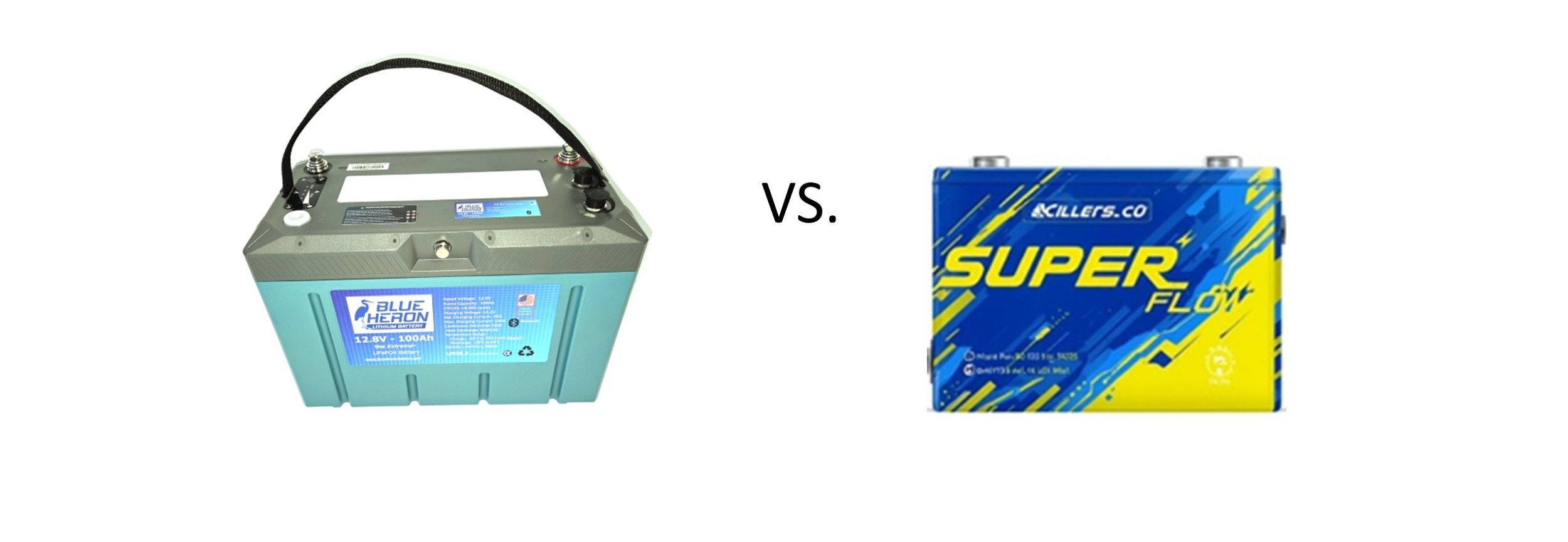
To try to illustrate with an example, let’s take a fictional battery “Super Flow” that claims 100Ah and a 6000 cycle life, selling on Teku for $189, although this is typical for many of these low-cost batteries. On opening the battery, we find the cells have a QR Code and are Champion cells rated at 1000 cycles. So, the claim of 6000 cycles is incorrect. 1000 cycle-rated cells are considered to be a 2-year life in a marine or RV house battery bank application, so a value of $95 per year. The Blue Heron Battery 100Ah Extreme that used much more expensive cells rated at 6000 cycles and an expected life of 15 years, has an annual cost of $52.60. So, the Blue Heron Battery is a much better value, and the “Super Flow” is over-priced.
2. Range of Added Features – The high-end batteries tend to have more features, with some being feature rich and others with moderate level of features, and the cheap batteries being very basic. These features can be quite extensive, and can include Bluetooth, CAN-Bus comms, external SoC LED scale, external ON-OFF switch, surface radiator to assist BMS heat removal, extra high current rating BMS, more rugged case, support Victron DVCC charging control, rugged cell compression for high current flow and longer life. The more one has of these the greater the value-added. These types of features add 10% to 30% over the value of cheap batteries without these features.
3. Exceptional Technical Support – Very few companies are able to offer this to the proper degree. Some try but don’t have the in-depth experience or engineering qualifications to give serious value-added benefit here. But if one receives this support, they get payback with a more straightforward system, better installation, better decisions on selection of options, better sizing of the battery bank, better system performance, and fewer issues down the road. These added-benefits may add a small amount to the selling price, but are valuable intangibles to consider in selecting a manufacturer.
4. Range of Sizes and Shapes – A manufacturer that has a wide range of physical sizes and shapes will help the consumer or dealer optimize the space available, and preserve precious space on a marine vessel or RV. This tends to be another value-added benefit that may not affect the battery cost. It may give the customer or dealer more capacity in a given space, and will typically minimize the space dedicated to the battery bank.
5. Capacity (Ah) - Some manufacturers use more modern and advanced technology cells, that have a higher energy density and smaller footprint. One can often gain capacity in the same space, with the added benefit of staying off the grid or without a generator running for a longer period than one with a smaller battery bank Ah capacity.
If one can find a manufacturer that hits all these factors, one can hit a homerun in a long life, low annual cost, high feature, reliable, large capacity, space efficient system. Not to mention the great experience of being guided professionally through the experience by receiving exceptional technical support.